
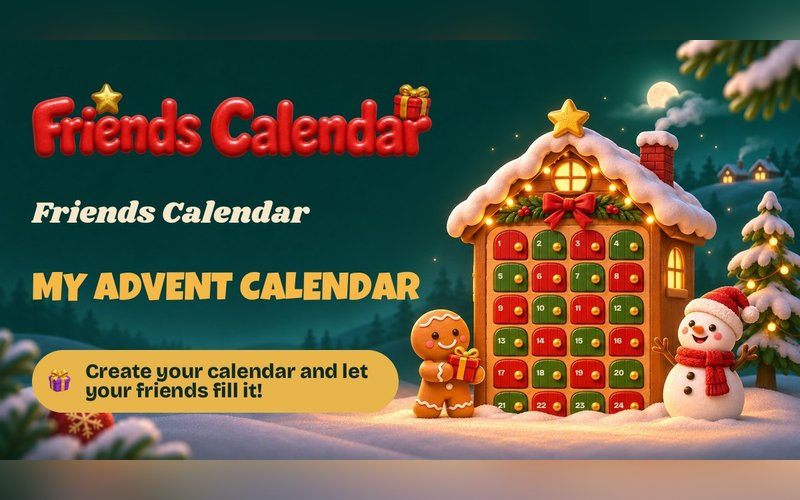
There's a specific kind of joy in opening a tiny cardboard door on a cold December morning. Behind it might be a chocolate shaped vaguely like a bell, a picture of a candle, or in fancier calendars a tiny tube of hand cream. It doesn't really matter. The point is the ritual: one small surprise a day, counting down to something bigger.
Friends Calendar keeps that ritual and changes who fills the doors. Instead of a factory, it's your friends who hide something behind each one.
A short history of the advent calendar
Advent calendars come from Germany. In the 1800s, many German families counted the days of Advent at home in simple ways, like marking chalk lines on a door, lighting a candle each day or adding a straw to a manger for every day of December.
Printed calendars arrived in the early 1900s. A Munich printer named Gerhard Lang is usually credited with the first commercially printed advent calendars. His early versions were cardboard sheets with little pictures for children to attach day by day, and his calendars soon became a commercial hit. Historians disagree on the exact years, and on who first added the little doors that became the standard format. Some accounts name other German printers as even earlier, but Lang's name is the one most often tied to the calendar's rise.
After the Second World War, printed calendars spread widely beyond Germany, and chocolate-filled versions became a holiday staple. Today you can find advent calendars for almost anything: tea, toys, beauty products, socks, even cheese. The format survived because it turns waiting into something fun.
How Friends Calendar works
- Create your calendar. You can do this before December starts, which gives your friends time to fill it.
- Share the link with friends and family.
- Friends hide gifts and messages behind your 24 doors.
- Open one door a day in December. In the UK edition, doors open from December 1 to December 25.
That last part is what makes it feel like a real advent calendar. You can't binge it. Each morning there's one new thing waiting, written by someone who was thinking about you.
Why it beats a chocolate calendar
A chocolate calendar is nice. A calendar full of messages from people who love you is a different level. One day it's an inside joke from your oldest friend. Another day it's a sweet note from your aunt, or a silly gift from a coworker. By Christmas, you've collected a little archive of how people feel about you.
It also works across distance. If your friends are spread over several cities or countries, everyone can still contribute. For long-distance friendships especially, a daily surprise from someone far away lands hard (in the good way). Our guide to keeping long-distance friendships alive has more ideas along these lines.
Tips for a great calendar
- Start early. The sooner you share your link, the more doors get filled before December 1.
- Ask a few friends to "own" a week. It spreads the doors out so you don't end up with ten messages on day 3 and nothing on day 20.
- Fill your friends' calendars too. It's a lovely way to give back, and it costs nothing but a few thoughtful minutes.
- Mix the tone. The best calendars have jokes, memories, compliments and one or two embarrassing photos.
- Save the best for last. Ask your closest friend to take the final door.
Stuck on what to write? Try a memory you share, something you admire about them, or a question from our list of deep questions to ask friends.
FAQ
When can I open my doors?
One door a day in December. In the UK edition, doors open from December 1 to December 25.
Can I create my calendar before December?
Yes, and it's a good idea. Creating it early gives friends time to fill the doors.
Is it free?
Yes. Friends Calendar is free to use in your browser.
Ready? Create your calendar now so your friends have time to fill every door.