Charades is one of those games that never needed an update. A few people, a room, one person trying to act out a movie title without speaking while everyone else shouts wrong answers. It has worked at family holidays, sleepovers and office parties for generations, and it still works for the same reason: watching people you know make fools of themselves is extremely fun.
Where charades comes from
Charades started out as a word game. In 18th-century France, a "charade" was a riddle where you described a word syllable by syllable, and the solver had to piece it together. The idea crossed to England, and in the 19th century it turned into something more theatrical. Victorian families played acted charades in their parlors, performing each syllable as a little scene, sometimes with costumes pulled from whatever was in the house.
The game shows up in famous novels of the time. In Charlotte Brontë's Jane Eyre, Mr. Rochester's guests stage an elaborate game of charades, and William Makepeace Thackeray's Vanity Fair features one too. It was the kind of entertainment people made for themselves before radio and TV filled the evenings.
The silent, mime-only version most people play today grew out of that tradition. The modern twist is the "forehead" style: the guesser holds a word they can't see, and everyone else gives clues. It flips the game so the person in the spotlight is the one guessing, not the one performing.
Why it works so well at parties
Charades is basically a perfect party game. It needs no setup and no rule lecture. People who barely know each other can play within a minute. And it rewards energy, not skill, so the most competitive person in the room has no real advantage over the friend who's just there for snacks.
It also creates moments. Somebody tries to act out "penguin" with total commitment. Somebody else describes "toaster" so badly that it becomes a running joke for the rest of the night. Those are the bits people remember. We go deeper on what makes a good night in our guide to a stress-free game night.
How the app works
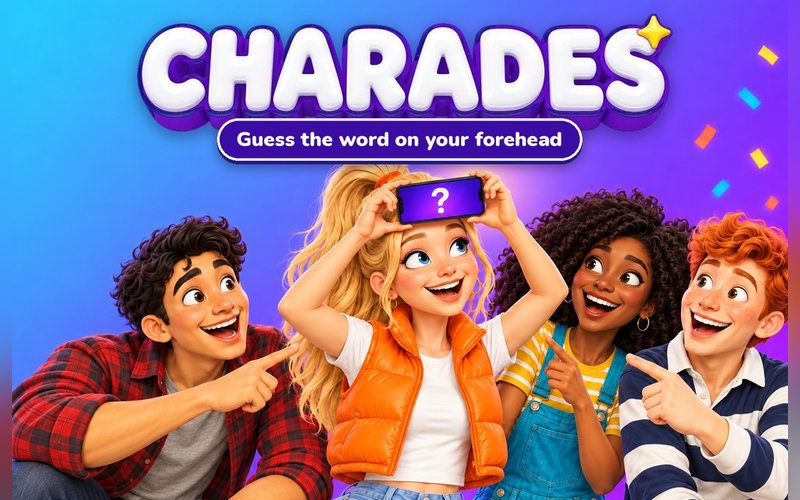
The app uses the heads-up format:
- Pick a category.
- Hold the phone on your forehead, screen facing your friends.
- Friends act out or describe the word they see.
- Tilt the phone down when you guess correctly, or tilt it up to pass.
- Keep going until time runs out, then count your score.
There are 50+ categories, with 5 free. Rounds can last from 30 to 120 seconds, or you can play untimed if your group prefers a slower pace.
The best feature might be the replays. The app records the guesser with the front camera, so after the round everyone can watch the person's face as they struggled through "kangaroo" or confidently yelled the wrong answer five times. Those clips are often funnier than the round itself.
The app has no ads, so nothing interrupts a round. There's an optional Premium subscription if you want more than the free categories.
Tips for a great round
- Mix acting and describing. Some words are easier to mime, others to explain. Let clue-givers choose.
- Short rounds for big groups. 30 to 60 seconds keeps the phone moving and nobody waits too long.
- Untimed for younger kids. Taking the clock away makes it calmer and kinder.
- Pass without shame. Tilting up to skip keeps the energy high. Fighting with one impossible word for a whole round does not.
- Watch the replays together. Seriously. That's where the biggest laughs are.
FAQ
How many players do I need?
You need at least one guesser and one person giving clues. More people means more chaos, which is usually better.
Does it have ads?
No. The app has no ads.
Is it free?
The app is free to download with 5 categories. A Premium subscription is optional.
Where can I get it?
It's available on the App Store and Google Play as "Charades · Forehead Game."
Ready? Grab your phone, gather your people, and put the first word on your forehead.